
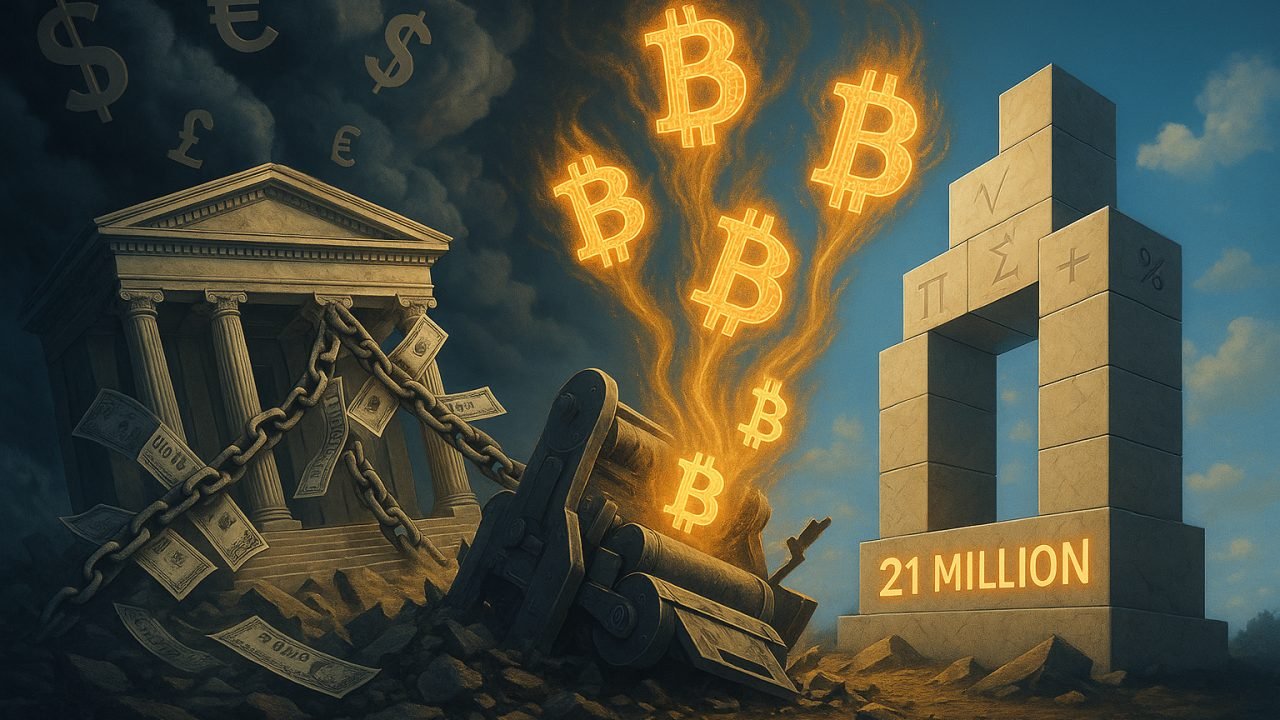
The concept we are discussing today is perhaps the most radical, the most revolutionary, and certainly the most mythological idea circulating in modern political economy: A state that lives within its means. We are speaking of a sovereign entity that operates under a balanced budget, where annual expenditures do not exceed annual revenues, and, critically, one that does not accumulate rolling, perpetual debt. This is not just fiscal prudence; this is an economic paradigm shift so profound that contemplating it reveals the fundamental rot within the current global financial architecture.
Has Such a Government Ever Existed?
In the modern context of complex nation-states managing massive social programs, entitlement spending, and vast military apparatuses, the answer is a resounding, definitive No. The fiscally responsible state is not merely an aspiration; it is a ghost story told to children before they learn how central banks operate.
The Historical Illusion: Why Debt is the Default Setting
To understand why the debt-free state is a fictional construct, we must first recognize the structural incentives inherent in modern governance, especially since the final severing of the gold link in 1971. Before the fiat era, during periods like the classical gold standard (1870-1914), governments were constrained by the necessity of settling international accounts in gold.
While they certainly accumulated debt-especially during major conflicts, the market imposed a natural, though often painful, limit to their borrowing capacity. Excessive debt accumulation could lead to a run on the nation’s gold reserves, triggering immediate fiscal crisis and deflationary pressure. Even historically prudent nations, however, found ways to rationalize borrowing.
The purpose of large-scale debt, historically, was always war financing or infrastructure building. Alexander Hamilton, in establishing the U.S. financial system, famously argued that “A national debt, if it is not excessive, will be to us a national blessing.” The idea was that debt created liquid assets, incentivized wealthy citizens to invest in the stability of the state, and provided necessary capital during emergencies. The key distinction between Hamilton's time and ours is scale and enforcement. In the pre-fiat world, the state had limited means to manufacture the money required to service the debt. Today, that constraint is gone. The enforcement mechanism has been replaced by the printing press.
The Definition of Discipline
A government truly living within its means would achieve the following:
- Revenue Maximization/Expenditure Minimization: Tax revenue must cover all operational costs, including defense, entitlements, and interest payments.
- Zero Net Borrowing: The government does not issue new bonds simply to finance structural deficits.
- Debt Reduction: Any existing debt must be systematically retired, not merely rolled over or inflated away.
We often hear of governments achieving temporary surpluses. Australia, Canada, and various European nations have, at times, managed to bring in more revenue than they spent for short periods. But a surplus merely slows the growth of the overall debt mountain. It does not eliminate the systemic reliance on debt as the primary tool of fiscal policy.
The few examples of nations operating debt-free are typically small, resource-rich states (like Brunei or Liechtenstein, which benefit from small populations and massive resource rents or financial specialization) or transient moments following periods of extreme austerity. These are anomalies, not models for complex, large-scale economies. The default state of the modern sovereign is debt accumulation, driven by political necessity and enabled by monetary magic.
The Political Economy of Perpetual Debt
The reason modern governments cannot-and structurally will not-live within their means is rooted in the political incentive structure of representative democracy coupled with central banking power.
- The Electoral Cycle Addiction
Politicians operate on two- to six-year cycles. Fiscal responsibility, which often requires painful cuts, tax hikes, or both, offers delayed, diffuse benefits (long-term economic stability) but immediate, concentrated costs (unhappy voters). Debt-financed spending, conversely, offers immediate, concentrated benefits (popular programs, tax cuts) while deferring the cost onto future generations. In a competitive democracy, the politician who proposes cutting popular programs to balance a budget is almost guaranteed to lose to the politician who promises to expand those programs, funding them with future debt. Debt becomes the ultimate political lubricant, allowing every voter to feel good now, while the cost is paid in the depreciated purchasing power of their grandchildren’s money.
- The Central Bank Enabler
This political addiction would be unsustainable if the market imposed honest interest rates. [1]If the U.S. Treasury had to pay 15% interest on $34 trillion in debt, the system would collapse overnight, forcing immediate austerity. However, the Federal Reserve (and other major central banks) acts as the ultimate enabler. By manipulating the short-term interest rate, engaging in Quantitative Easing (QE), and maintaining the illusion of liquidity, the central bank ensures that the government can borrow at rates far below the true risk profile associated with perpetual debt expansion.
This is the Fiat Loop: The government spends beyond its means → The Treasury issues bonds → The market struggles to absorb them naturally → The Central Bank steps in to purchase or influence the pricing of those bonds, often monetizing the debt → This lowers the cost of borrowing for the government → The government is incentivized to borrow more.
This mechanism fundamentally destroys the concept of "living within your means." When the money printer is operational, the means are infinitely expandable, but only in nominal terms. The real cost is paid via inflation-the silent, regressive tax that hits the poor and fixed-income earners hardest.
The Sovereignty of Scarcity: How Bitcoin Forces Honesty
The New School thesis dictates that structural problems require structural solutions. We cannot vote our way out of the debt spiral because the problem is not a lack of morality among politicians, but a lack of enforcement within the monetary system. If the government were forced to operate on a truly hard, non-inflatable money-a Bitcoin standard-the entire political calculus would invert.
- The Hard Budget Constraint
Bitcoin introduces the concept of the Hard Budget Constraint at the sovereign level. [2]If a government wishes to spend 100 billion units of value, and its tax revenue is only 80 billion, it has three choices under a fiat regime: raise taxes, cut spending, or print 20 billion. It almost always chooses the third option. Under a Bitcoin Standard (or even a system where significant national reserves and sovereign debt instruments were denominated in BTC), the third option vanishes. The supply of BTC is fixed, verified, and immutable.
A government cannot conjure 20 billion units of BTC into existence to cover its deficit. This forces immediate, painful, but necessary economic honesty. The government must either increase the productivity of its citizens (allowing higher tax revenue without higher rates) or immediately cut spending to meet its means. There is no middle ground, no deferred cost, and no monetary escape valve. ####
- Disciplining the Market
Currently, the bond market is a dysfunctional mechanism of price discovery because it constantly anticipates central bank intervention. When rates rise too high, the market expects the Fed to pivot and inject liquidity. If sovereign debt were priced in a sound, non-manipulable asset like Bitcoin, the market discipline would be swift and brutal. Excessive borrowing would instantly translate into higher, unmanageable interest rates (denominated in BTC), forcing the defaulting state to restructure or face collapse. This is how a true market should operate, rewarding fiscal prudence and punishing recklessness. Bitcoin does not care about electoral cycles, partisan politics, or Keynesian models. [3]It only cares about the cryptographic proof of work and the 21 million supply cap. This indifference is precisely what makes it the ultimate tool for achieving sovereign fiscal discipline.
The Fictional State Becomes Necessary
The fictional state-the government that lives within its means-is not an unattainable utopia. it is the necessary consequence of operating on honest money. We often imagine that a fiscally disciplined government would be one that simply adheres to stricter rules imposed by legislation (like the various failed attempts at balanced budget amendments). This misses the point entirely. Rules written on paper can be repealed, ignored, or inflated away.
The only rule that cannot be repealed is the law of thermodynamics and the cryptographic impossibility of generating more Bitcoin. A state operating without debt would fundamentally shift the power dynamic:
From Financial Engineering to Real Production:
Capital would flow back into productive assets (infrastructure, R&D, genuine innovation) rather than being trapped in the fixed-income market funding government deficits.
Reduced Imperial Overstretch:
The ability to fund endless wars and global military presence-a hallmark of modern sovereign debt-would be severely curtailed. Wars would have to be paid for in real time, dramatically raising the political cost.
Abolition of the Inflation Tax:
Citizens would retain the full value of their labor and savings, as the government could no longer steal purchasing power through quantitative easing. In conclusion, the question of whether a government has ever lived within its means is secondary to the question of why they no longer can.
The shift to a pure fiat standard removed the structural check that scarcity imposes. The government’s addiction to debt is simply a rational response to an irrational monetary system that provides infinite liquidity at zero perceived cost. For humanity to return to an age of sustainable, honest governance-where the government operates under a budget constraint-we must first adopt a monetary system that physically enforces scarcity.
The New School recognizes that Bitcoin is not just digital gold; it is the ultimate tool for enforcing fiscal sobriety upon the state, transitioning the mythological concept of the balanced budget into a structural reality. The future of economic sovereignty depends entirely on our ability to enforce the laws of mathematics over the laws of man. The debt spiral ends when the money printer breaks, and Bitcoin is the unfixable break switch.
Sources
[1] Congressional Budget Office (CBO) - https://www.cbo.gov/publication/59993
[2] International Monetary Fund (IMF) - https://www.imf.org/en/Data/Statistics/WEO/WEO-Database
[3] Bitcoin Whitepaper (Satoshi Nakamoto) - https://bitcoin.org/bitcoin.pdf