
Matthew Halfacre 10/30/2025
When wealthy families transfer wealth across generations, they don't hand over a single asset class. They provide a carefully balanced portfolio: cash for liquidity, real estate for tangible productive assets, and gold for long-term value preservation. Everything else, stocks, bonds, businesses, etc are treated as speculation on future productivity. This framework has preserved wealth for centuries because it recognizes a fundamental truth: not all assets serve the same purpose.
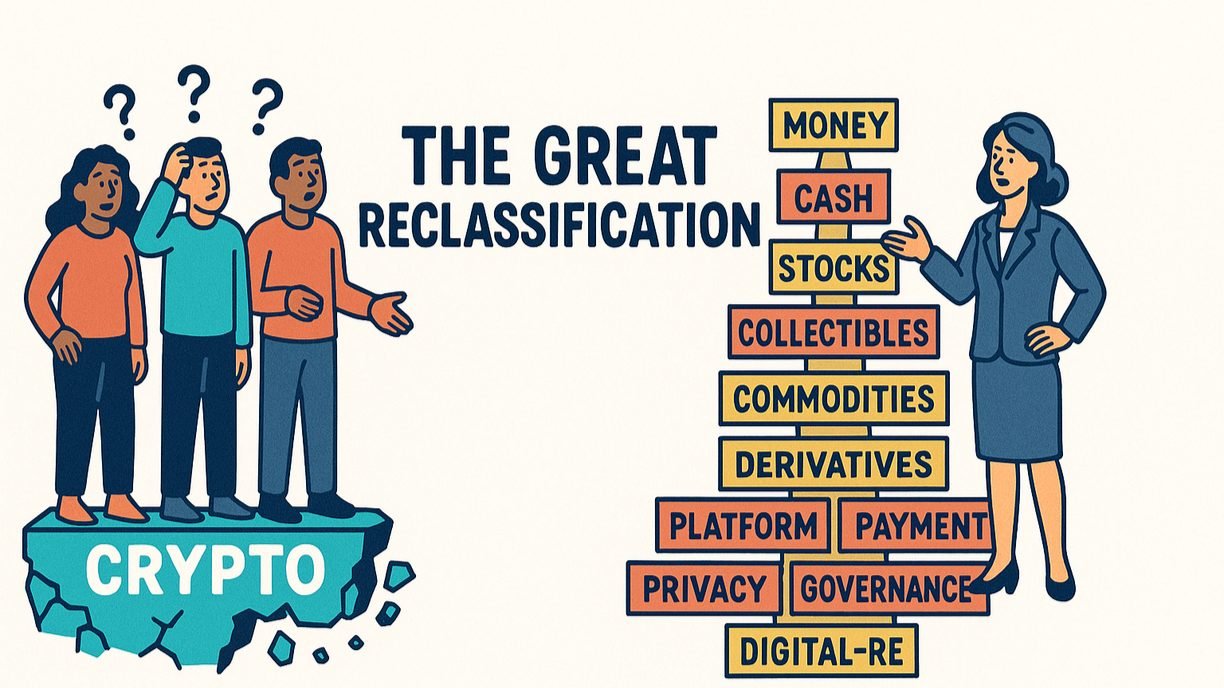
The digital asset world is undergoing a similar reckoning. What we casually call "cryptocurrency" is not a single asset class but a collection of at least eleven distinct categories, each serving a different function. By 2030, the cyrpto markets will have separated into these categories, and investors will approach them with the same clarity that wealthy families apply to traditional assets.
This edition breaks down the eleven categories, explains what each one actually represents, and reveals why Bitcoin is positioned to become the measuring stick for the entire digital economy.
Six Traditional Classes and Five New Classes
While most "crypto" is simply digitized versions of existing assets, blockchain technology has created five genuinely novel asset classes that did not exist in the pre-digital world.
1. Money - Traditional Equivalent: Gold - Digital Asset Equivalent: Bitcoin
As long as the currencies were backed by Gold, things were fine. Once they stopped being backed by Gold, look what happened.
Bitcoin is the only digital asset that functions as true money. It is decentralized, secured by proof-of-work energy expenditure, has a fixed supply of 21 million coins, and operates without central control. While thousands of tokens claim to be "currencies," Bitcoin alone has achieved the level of decentralization, security, and global acceptance necessary to serve as a monetary asset.
Bitcoin's energy-backed proof-of-work gives it intrinsic value in the same way gold's scarcity and physical properties give it value. By 2030, Bitcoin will be recognized not as "a cryptocurrency" but as digital money, a store of value that sits alongside gold and real estate in the wealth preservation tier. In the traditional financial world, every asset is ultimately measured against foundational stores of value. A stock's performance is measured in dollars, but those dollars are measured in how much gold, real estate, or purchasing power they can bring. Similarly, in the digital world, a token's performance will be measured in how much Bitcoin, Gold, Real Estate, or purchasing power it can provide.
Everything else besides Gold, Real Estate, and Bitcoin will be measured against them to derive their true value. Stocks, bonds, businesses, etc are speculation on future productivity. These assets may generate wealth, but they do not preserve it across generations. The digital asset world is evolving toward the same structure. By 2030, Bitcoin will emerge as the measuring stick for the entire digital economy. Just as traditional assets are ultimately valued in terms of how much gold or real estate they can purchase, digital assets will be valued in terms of how much Bitcoin they can command.
This shift is already underway. Experienced cryptocurrency traders measure altcoin performance in "BTC pairs" rather than dollar pairs. They ask: "Is this token outperforming Bitcoin?" By 2030, this will be explicit and universal. Bitcoin will serve as the reference point for measuring value across the entire digital ecosystem.
The reason is simple: Bitcoin is the only digital asset that functions as money. Platform tokens are utilities. Stablecoins are claims on dollars. Governance tokens are voting rights. Only Bitcoin is money itself. It is scarce, decentralized, and energy-backed.
2. Cash (paper money or fiat currency)
Traditional Equivalent: Money market funds, Treasury bills, checking accounts
Digital Assets Equivalents: Tether (USDT), USD Coin (USDC), DAI, PayPal USD (PYUSD), First Digital USD (FDUSD), Ripple USD (RLUSD)
Stablecoins are digital representations of fiat currencies, typically backed 1:1 by dollars or other reserve assets. They serve the same function as cash in a traditional portfolio: liquidity and ease of transaction. Stablecoins are not competitors to Bitcoin; they are competitors to traditional banking payment rails.
These assets offer faster settlement and lower costs than wire transfers, but they carry all the risks of centralization: censorship, seizure, and reliance on the issuer's solvency. By 2030, stablecoins will be regulated like money market funds, with reserve requirements, regular audits, and government oversight. They are useful tools for liquidity but should never be confused with stores of value.
3. Equities
Traditional Equivalent: Corporate stock
Digital Assets Equivalents: Binance Coin (BNB), OKB, KuCoin Token (KCS), Gate Token (GT), Crypto.com Coin (CRO)
Exchange tokens are equity in centralized cryptocurrency exchanges. Owning BNB is functionally equivalent to owning shares in Binance. These tokens often provide fee discounts, governance rights, or profit-sharing mechanisms. These are all characteristics of traditional corporate equity structure.
By 2030, these will be regulated as securities, with disclosure requirements and investor protections similar to stocks. They are speculative investments in the success of specific companies, not stores of value.
4. Collectibles
Traditional Equivalent: Art, antiques, rare coins, trading cards
Digital Assets Equivalents: NFTs (Bored Ape Yacht Club, CryptoPunks, digital art), Memecoins (Dogecoin, Shiba Inu, Pepe)
Non-fungible tokens and memecoins both fall into the collectibles category. NFTs represent unique digital items. These items can be art, gaming assets, or virtual memorabilia. Memecoins are fungible but derive their value purely from cultural relevance and speculation, much like limited-edition trading cards or Beanie Babies.
These assets can appreciate dramatically based on trends and social consensus, but they are not wealth preservation tools. By 2030, NFTs will be taxed and regulated like art, while memecoins will likely face restrictions similar to gambling or lottery tickets.
5. Commodities
Traditional Equivalent: Gold bars, silver bullion, oil futures
Digital Assets: PAX Gold (PAXG), Tether Gold (XAUt)
These tokens are backed 1:1 by physical commodities, typically gold. They offer the convenience of blockchain-based ownership and transfer without the need to store physical assets. However, they are not new assets, they are simply tokenized claims on existing commodities.
By 2030, commodity-backed tokens will be regulated like commodity futures or ETFs, with strict custody and redemption requirements. They serve as a bridge between traditional and digital finance but do not represent a new form of value.
6. Derivatives
Traditional Equivalent: Options, futures, swaps, structured products
Recommended by LinkedIn
[
Bringing stablecoins & assets to Bitcoin 👀; Narrowing…
Linas Beliūnas
4 years ago](https://www.linkedin.com/pulse/bringing-stablecoins-assets-bitcoin-narrowing-gap-between-beli%C5%ABnas)
[
Bitcoin Surges Past $72,000: The Cryptocurrency…
Geco Capital OÜ
7 months ago](https://www.linkedin.com/pulse/bitcoin-surges-past-72000-cryptocurrency-markets-hopeful-r2igf)
[
Bitcoin’s Next Test: Can Institutional Demand Carry…
Dipanshu Chaudhry
4 months ago](https://www.linkedin.com/pulse/bitcoins-next-test-can-institutional-demand-carry-crypto-chaudhry-vpdmc)
Digital Assets: Wrapped Bitcoin (WBTC), synthetic assets, leveraged tokens
Wrapped tokens and synthetic assets are derivatives of underlying cryptocurrencies or traditional assets. WBTC, for example, is Bitcoin on the Ethereum blockchain. This is simply a derivative that tracks Bitcoin's price but introduces counterparty risk. Leveraged tokens amplify exposure to price movements, similar to options or futures.
By 2030, these will be regulated like traditional derivatives, with margin requirements, counterparty risk disclosures, and exchange oversight. They are tools for traders and speculators, not for wealth preservation.
7. Platform/Computing Tokens
No Traditional Equivalent
Digital Assets: Ethereum (ETH), Solana (SOL), Cardano (ADA), Avalanche (AVAX), Polkadot (DOT), Chainlink (LINK)
These tokens represent ownership or utility in decentralized computing networks. Ethereum, for example, is a global computer where anyone can deploy applications without permission. Owning ETH gives you the right to use this computing power and participate in network governance.
This is fundamentally new. You could never buy "shares" in the TCP/IP protocol or the HTTP standard, even though these protocols created trillions of dollars in value. Platform tokens allow you to own a piece of the infrastructure itself.
However, these are not money. They are speculative bets on the adoption and utility of specific computing platforms. By 2030, platform tokens will likely be regulated as a hybrid between commodities (for their utility) and securities (for their investment characteristics). They belong in the "speculation" bucket of a portfolio, not the "wealth preservation" bucket.
8. Payment Rail Tokens
No Traditional Equivalent
Digital Assets: XRP, Stellar (XLM)
These tokens are not money themselves but infrastructure for moving value. XRP, for instance, serves as a bridge currency for cross-border payments between banks. When a bank in the United States needs to send euros to a bank in Germany, it can convert dollars to XRP, send the XRP across the XRP Ledger in seconds, and have the receiving bank convert XRP to euros.
This is analogous to owning utility credits in the SWIFT network, if such a thing existed. Payment rail tokens have utility, but they are not stores of value. Their value depends entirely on the adoption and efficiency of the payment network they support.
By 2030, payment rail tokens will be regulated based on their specific use cases, likely requiring licenses similar to money transmitters. They are tools, not assets for wealth preservation.
9. Privacy Tools
No Traditional Equivalent
Digital Assets: Monero (XMR), Zcash (ZEC)
Privacy coins are designed for anonymous, untraceable transactions. They are less like assets and more like software tools. These are comparable to encryption programs or VPN services. While privacy is a legitimate goal, these assets face significant headwinds.
By 2030, privacy coins will face intense regulatory pressure and may be banned or heavily restricted in most jurisdictions due to concerns about money laundering, tax evasion, and illicit finance. They serve a niche use case but are unlikely to achieve mainstream adoption or function as stores of value.
10. Governance Tokens
No Traditional Equivalent
Digital Assets: Uniswap (UNI), Aave (AAVE), Maker (MKR), Curve (CRV), Lido DAO (LDO)
Governance tokens grant voting rights in decentralized protocols. They are similar to corporate voting shares but without the profit-sharing or ownership characteristics of traditional equity. Holding UNI, for example, allows you to vote on changes to the Uniswap protocol but does not entitle you to a share of the protocol's revenue.
By 2030, governance tokens will likely be regulated as securities, though their decentralized nature may create enforcement challenges. They are speculative bets on the success of specific protocols, not wealth preservation assets.
Implications for Investors
Understanding this reclassification has profound implications for how investors should approach digital assets. When you invest in "crypto," you are not making a single bet—you are choosing between eleven fundamentally different asset classes, each with its own risk-return profile and purpose.
Investing in Bitcoin is a bet on digital money replacing or supplementing fiat currencies and gold as a store of value. It belongs in the wealth preservation tier of a portfolio, alongside physical real estate and precious metals.
Investing in stablecoins is not an investment at all. It is simply a cash management tool for liquidity and transactions.
Investing in Ethereum is a bet on decentralized computing becoming a major industry. It is speculation on future productivity, similar to investing in a tech stock.
Investing in XRP is a bet on a specific payment infrastructure gaining adoption. It is a speculative bet on utility, not a store of value.
Investing in a memecoin is gambling, not investing. It may be entertaining and occasionally profitable, but it has no place in a wealth preservation strategy.
By 2030, the markets will have forced this clarity. Regulators will treat each category differently. Institutional investors will allocate capital based on the specific characteristics of each class. And Bitcoin, as the only true money in the digital realm, will serve as the reference point for measuring value across the entire ecosystem.
Conclusion
The term "cryptocurrency" obscures more than it clarifies. What we call "crypto" today is actually eleven distinct asset classes. There are six digitized versions of traditional assets and five genuinely new categories enabled by blockchain technology.
The winners in this transition will be those who understand the distinction early. The winners will be those who recognize that not all digital assets are created equal, and that Bitcoin's role as money makes it fundamentally different from everything else in the space. By 2030, this will be obvious. The question is whether you will position yourself accordingly before the market forces that clarity upon everyone else.