
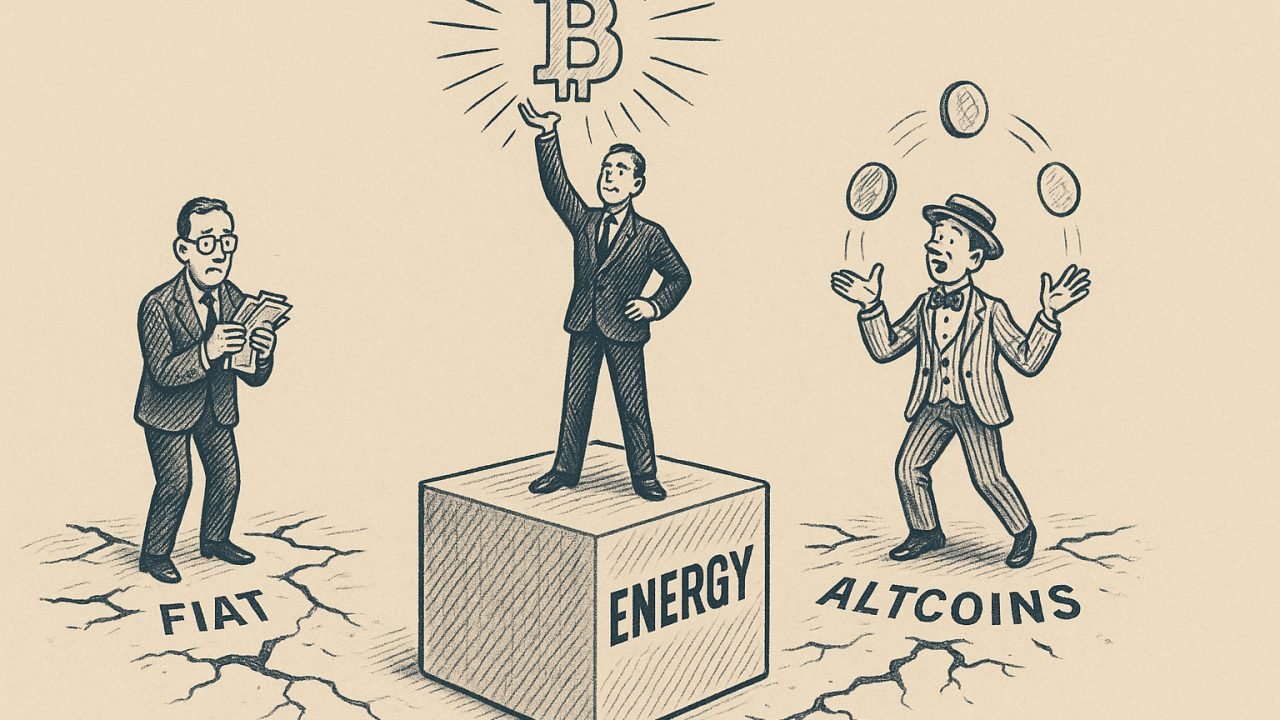
"Bitcoin has no intrinsic value."
This phrase has become the rallying cry of financial traditionalists, central bankers, and crypto skeptics alike. It is repeated with such frequency and confidence that it has achieved the status of accepted wisdom. It is a thoughtless cliché that requires no further examination. This statement is not just wrong, it is fundamentally backwards and it reveals a profound misunderstanding of what value actually is and where it comes from.
The "intrinsic value" argument is the financial equivalent of an NPC dialogue loop. It is a pre-programmed talking point that short-circuits critical thinking. Those who deploy it rarely stop to ask what intrinsic value means. Do fiat currencies possess it, can an algorithm/protocol be valuable, or what does proof-of-work even mean? When examined closely, the talking point collapses entirely, and in its place emerges a startling truth: Bitcoin may possess the most genuine intrinsic value of any monetary asset in human history.
Deconstructing "Intrinsic Value": What Does It Actually Mean?
The term "intrinsic value" is thrown around carelessly, but what does it actually signify? In classical economics, intrinsic value refers to the inherent worth of an asset derived from its fundamental properties which is independent of it's market perception or external factors. Gold, for instance, is said to have intrinsic value because it has industrial uses, aesthetic appeal, and physical scarcity rooted in geology.
But here's the critical question: Does the U.S. dollar have intrinsic value? Does the euro? Does any fiat currency?
The answer is an unequivocal no. Fiat currencies are backed by nothing but government decree and the collective belief that they will be accepted for goods and services. They can be printed in unlimited quantities at the discretion of central banks. The dollar's "value" is not intrinsic; it is entirely extrinsic. It is a function of legal tender laws, taxation, and network effects. When you strip away the government's enforcement power, and a dollar bill is just paper and ink.
Yet the same critics who dismiss Bitcoin for lacking intrinsic value rarely apply this standard to the fiat system they defend. This reveals that the argument is truly just a defense mechanism for the status quo. It is simply a re-hashed talking point that has been perpetuated since the launch of Bitcoin.
The Algorithm Paradox: When Protocols Create Trillions
When diving into Bitcoin's unique energy-backed value, it's worth addressing an even more fundamental absurdity in the "no intrinsic value" argument. This next absurdity is the selective amnesia about how algorithms and protocols have created value throughout the digital age.
Consider the protocols that underpin the modern internet. TCP/IP, the communication protocol that enables data transmission across networks, has no "intrinsic value" by the critics' definition. It's just code. It's an algorithm for routing packets. Yet it has enabled trillions of dollars in economic activity and is the foundation of the entire digital economy. HTTP and HTTPS, the protocols that power web browsing and secure communications, are similarly "just algorithms." Yet HTTPS alone enabled the explosion of e-commerce, online banking, and digital services that now represent a substantial portion of global GDP.
SMTP, the Simple Mail Transfer Protocol, handles over 333 billion emails daily as of 2025. It's an algorithm. Does it have intrinsic value? By the logic applied to Bitcoin, it should be worthless. Yet it facilitates global business communication and has created immeasurable economic value.
Google's PageRank algorithm, the mathematical formula that ranks web pages, transformed a graduate research project into a company worth over $2 trillion. It's an algorithm, it's just a set of mathematical instructions. Where is its intrinsic value? In the code itself? In the servers running it? Or in the fact that it solves a valuable problem and people choose to use it?
RSA encryption, the algorithm that secures government communications, financial transactions, and sensitive data worldwide, is pure mathematics. It has no physical form, no industrial use beyond computation, and no "backing." Yet it is foundational to global cybersecurity and commerce. Its value is unquestioned because its utility is undeniable.
The pattern is clear: algorithms and protocols create value by solving problems, establishing standards, and enabling coordination. Their value is not intrinsic in the classical sense. It is derived from adoption, network effects, and the real-world utility they provide. Yet no serious person questions whether TCP/IP or HTTPS "has value." The question is absurd on its face.
So why is Bitcoin, a protocol that solves the double-spending problem and creates a decentralized monetary system, held to a different standard? The answer is simple. Bitcoin threatens entrenched interests in a way that communication protocols do not. The "no intrinsic value" argument is not applied consistently. It is deployed selectively to dismiss a technology that challenges the monopoly on money creation.
The Energy Standard: Bitcoin's Unforgeable Costliness
Bitcoin does not derive its value from government backing or industrial utility. It derives it from something far more fundamental: energy. Every Bitcoin that exists was created through an immense expenditure of computational power, which translates directly into real-world electricity consumption. This is not incidental; it is the entire design of the proof-of-work system.
Proof-of-work creates what cryptographer Nick Szabo termed "unforgeable costliness." This is a property that makes Bitcoin prohibitively expensive to produce or counterfeit. To create a Bitcoin, miners must solve complex cryptographic puzzles, a process that requires specialized hardware and vast amounts of electricity. This energy expenditure is not wasted; it is the mechanism that secures the network and guarantees scarcity.
As of 2025, Bitcoin mining has become a sophisticated energy market participant, with 52.4% of its energy mix coming from renewable sources, including nuclear, wind, hydro, and solar [1]. Far from being an environmental liability, Bitcoin mining is increasingly recognized as a tool for grid stabilization, renewable energy integration, and the monetization of otherwise wasted energy sources like flared natural gas and landfill methane [2].
This energy backing is Bitcoin's intrinsic value. It is a direct, physical connection to the real world. This is a connection that fiat currency, created with a keystroke, simply does not have.
The Altcoin Illusion: Speculation Masquerading as Innovation
If Bitcoin's energy-backed scarcity represents genuine intrinsic value, then the thousands of alternative cryptocurrencies represent its opposite: value by proclamation. The altcoin market is a speculative casino where new tokens are conjured into existence with minimal cost, marketed with grand narratives, and discarded when the hype fades.
Consider Ethereum, the most prominent alternative to Bitcoin. While Ethereum has transitioned to a Proof-of-Stake (PoS) consensus mechanism, this shift has not created intrinsic value, it has eliminated it. PoS requires no energy expenditure, no unforgeable costliness, and no real-world anchor. Instead, it replicates the very system Bitcoin was designed to replace, which is a "rich get richer" model where those with the most capital control the network.
Recommended by LinkedIn
[
Gold, Silver — What Is Actually Going On?
Sergey Romanchuk
8 months ago](https://www.linkedin.com/pulse/gold-silver-what-actually-going-sergey-romanchuk-9peqf)
[
₿itcoin—No Heads, No Tails—an opinion piece
Michael Ashley Schulman CFA
5 years ago](https://www.linkedin.com/pulse/itcoinno-heads-tailsan-opinion-piece-michael-ashley-schulman-cfa)
[
What is the Best Time to Trade Crypto?
Kirubakaran Rajendran
11 months ago](https://www.linkedin.com/pulse/what-best-time-trade-crypto-kirubakaran-rajendran-vhngc)
The performance data tells the story. Between October 2020 and October 2025, Bitcoin delivered a 832.6% return, while Ethereum managed just 9.2% over the same period [3]. This is not a temporary divergence. It is the market recognizing the difference between an asset with genuine scarcity and a speculative token with no energy moat.
Bitcoin, Gold, and Real Estate: The Real Asset Trinity
Critics who claim Bitcoin has no intrinsic value inadvertently reveal that they do not understand how value is created in the physical world. The most enduring stores of value in human history, gold and real estate, are valuable precisely because they require real-world resources to obtain.
•Gold must be extracted from the earth through energy-intensive mining, refining, and transportation. Its scarcity is a function of geology and physics.
•Real Estate is limited by physical space and requires labor, materials, and capital to develop. Its value is tied to location, utility, and scarcity.
•Bitcoin must be mined through computational work, consuming electricity and hardware. Its scarcity is guaranteed by mathematics and thermodynamics.
All three assets share a common foundation: they cannot be conjured from nothing. They require energy, effort, and resources to create. This is the essence of intrinsic value, not industrial utility or aesthetic appeal, but the unforgeable costliness that prevents arbitrary inflation.
Fiat currency fails this test. Altcoins fail this test. Only Bitcoin, gold, and real estate pass.
Bitcoin as Strategic Infrastructure: The Sovereignty Dividend
The "no intrinsic value" argument also ignores Bitcoin's rapidly growing role as strategic national infrastructure. Bitcoin mining is not merely a financial activity; it is an energy policy tool that supports grid stability, renewable energy development, and national energy independence.
Bitcoin miners act as flexible load participants, absorbing excess energy during periods of low demand and powering down during peak usage. This capability makes renewable energy sources like wind and solar more economically viable by providing a guaranteed buyer for surplus electricity. In the United States, Bitcoin mining now accounts for an estimated 0.6% to 2.3% of total electricity consumption [4], and it is increasingly being deployed to monetize stranded energy assets. These include remote hydroelectric plants to methane emissions from landfills.
This is not abstract theory. It is happening now, and policymakers are taking notice. Bitcoin mining is being integrated into America's strategic energy plans because it transforms wasted energy into portable, sovereign value. There is no other cryptocurrency offers this capability, also, there is no fiat system that can replicate it.
The Real Divide: Sovereignty vs. Control
The "Bitcoin has no intrinsic value" talking point is not an economic argument. It is an ideological argument. It is the language of a globalist financial system that depends on centralized control and the ability to create money at will. Bitcoin threatens this model by offering an alternative: a monetary system grounded in energy, mathematics, and individual sovereignty.
The choice is clear. On one side lies the fiat system, where value is decreed by central banks and eroded through inflation. On the other side lies the altcoin casino, where speculative tokens are marketed as innovation but offer no real scarcity or security. Then there is Bitcoin which stands apart from both fiat currencies and the other cryptocurrencies. Bitcoin is the only energy-backed, mathematically scarce, and increasingly recognized, foundational asset which stands alongside gold and real estate as true stores of value.
The next time someone repeats the tired refrain that "Bitcoin has no intrinsic value," ask them to define intrinsic value. Ask them if the dollar has it. Ask them why energy expenditure doesn't count. The conversation will end quickly, because the talking point cannot survive scrutiny.
Bitcoin's intrinsic value is not a matter of opinion. It is a matter of physics.
References
[1] SQ Magazine. (2025, October 16). Bitcoin Energy Consumption Statistics 2025: Insights. Retrieved from https://sqmagazine.co.uk/bitcoin-energy-consumption-statistics/
[2] MARA. (2024). Cashing in on Trash: Bitcoin Mining Offers an Economical Solution to Methane Emissions. Retrieved from https://www.mara.com/posts/cashing-in-on-trash
[3] Statmuse. (2025, October 19). Btc Vs Eth Last 5 Years. Retrieved from https://www.statmuse.com/money/ask/btc-vs-eth-last-5-years
[4] U.S. Energy Information Administration. (2024, February 1). Tracking electricity consumption from U.S. cryptocurrency mining. Retrieved from https://www.eia.gov/todayinenergy/detail.php?id=61364