
October 5, 2025
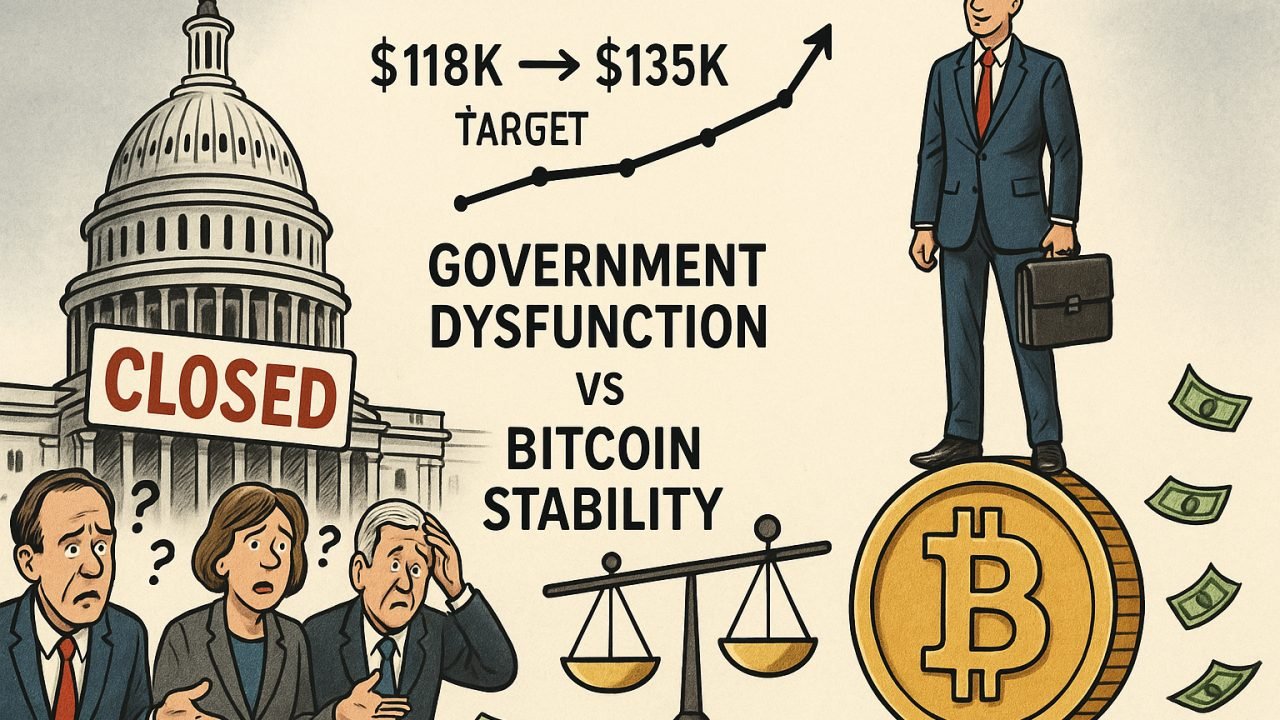
The United States government shutdown entering its fifth day has created an unprecedented natural experiment in Bitcoin's evolution as a monetary asset. While federal agencies furlough over 90% of their workforce and the economy bleeds $15 billion per week according to White House estimates, Bitcoin has demonstrated remarkable resilience, climbing from $118,000 to $125,000 as traditional financial systems strain under political paralysis.
This shutdown differs fundamentally from previous government funding crises because it occurs during Bitcoin's institutional maturation phase. The result is a real-time stress test of Bitcoin's safe haven thesis that extends far beyond theoretical monetary arguments into practical portfolio management during systemic governance failure.
The Economic Hemorrhaging: $15 Billion Weekly GDP Loss
The Congressional Budget Office estimates each week of shutdown costs the U.S. economy $15 billion in lost GDP, with a month-long shutdown potentially reducing annual growth by 0.4 percentage points. This economic damage stems from furloughed federal workers, delayed government contracts, and reduced business confidence as political dysfunction undermines economic stability.
Federal purchases of goods and services have already dropped at a 5.4% annual rate in real terms during the first half of 2025, even before the shutdown began. The current crisis accelerates this decline as government agencies halt non-essential operations and delay procurement decisions, creating ripple effects throughout the economy.
The shutdown's timing coincides with critical economic data releases, creating information gaps that complicate Federal Reserve policy decisions. The Bureau of Labor Statistics has suspended employment reports, while the Commerce Department cannot release GDP data, leaving markets operating with incomplete information about economic conditions.
Small businesses face particular challenges as the Small Business Administration has suspended loan approvals, while federal contractors experience payment delays that strain cash flow. These microeconomic impacts aggregate into macroeconomic headwinds that threaten the broader recovery trajectory, while Bitcoin operates independently of these government-dependent systems.
Regulatory Vacuum: Crypto Enforcement Paralyzed
The Securities and Exchange Commission has furloughed over 90% of its workforce, effectively suspending cryptocurrency enforcement actions and regulatory guidance during the shutdown. The Commodity Futures Trading Commission operates with just 5.7% of its normal staff, creating a regulatory vacuum in cryptocurrency oversight.
This regulatory paralysis occurs as the crypto industry awaits critical policy decisions on Bitcoin ETF expansions, stablecoin regulations, and digital asset custody rules. The shutdown delays these decisions while Bitcoin continues operating normally, highlighting the contrast between regulatory dependency and technological autonomy.
The Treasury Department's Financial Crimes Enforcement Network (FinCEN) has also suspended most operations, reducing anti-money laundering oversight and compliance monitoring. Despite this regulatory absence, Bitcoin's blockchain continues providing transparent transaction records that exceed traditional banking surveillance capabilities.
International regulatory coordination has stalled, as U.S. agencies cannot participate in global cryptocurrency policy discussions. This creates opportunities for other jurisdictions to advance Bitcoin-friendly regulations while American policymakers remain sidelined by domestic political dysfunction.
Mining Operations: Unaffected by Federal Paralysis
Bitcoin mining operations continue normal operations despite the government shutdown, demonstrating the industry's independence from federal oversight and infrastructure. Unlike traditional energy sectors that rely on federal permits and regulatory approvals, Bitcoin miners operate under existing state and local authorities that remain functional during federal shutdowns.
The Department of Energy's suspension of data collection means the government cannot monitor Bitcoin mining energy consumption or environmental impacts during the shutdown. This regulatory blind spot occurs as mining operations expand across multiple states, with Texas alone hosting over 25% of U.S. mining capacity.
Federal agencies responsible for monitoring cryptocurrency mining near military installations, including F.E Warren Air Force Base in Wyoming, have suspended oversight activities. The Treasury Department's investigation of mining operations within one mile of strategic missile bases remains on hold, allowing continued expansion without federal interference.
The shutdown also delays implementation of new environmental regulations targeting proof-of-work mining, as the Environmental Protection Agency operates with minimal staff. This regulatory pause provides mining operators additional time to optimize operations without new compliance burdens.
International Dollar Alternatives: Accelerating Adoption
Foreign governments and institutions are accelerating Bitcoin adoption as the shutdown demonstrates American political instability and fiscal irresponsibility. The inability to pass basic funding legislation raises questions about U.S. governance competence and dollar reliability as the global reserve currency.
Central banks in emerging markets are increasing Bitcoin allocations as hedge against dollar volatility and political risk. El Salvador's Bitcoin treasury strategy, previously viewed as experimental, now appears prescient as other nations consider similar approaches to reduce dollar dependency.
The shutdown occurs as BRICS nations advance alternative payment systems designed to bypass dollar-denominated transactions. Bitcoin's neutral, borderless nature positions it as a bridge currency for international trade that avoids both dollar exposure and alternative government-controlled systems.
European institutions are also reassessing dollar reserves in light of recurring American political crises. The European Central Bank's recent research on Bitcoin as a reserve asset gains relevance as shutdown-induced uncertainty undermines confidence in American institutional stability.
Corporate Treasury Revolution: Crisis-Driven Adoption
Corporate treasuries are accelerating Bitcoin adoption as the shutdown validates concerns about government reliability and fiscal sustainability. Companies with significant government contract exposure are particularly motivated to diversify into assets independent of political decision-making processes.
Strategy's (formerly MicroStrategy) Bitcoin treasury approach has gained credibility as the shutdown demonstrates the risks of relying on government stability for business operations. The company's $42 billion Bitcoin position provides insulation from shutdown-related economic disruption.
Defense contractors face particular challenges as Pentagon procurement delays threaten cash flow and project timelines. These companies are exploring Bitcoin treasury strategies to reduce dependence on government payment reliability and provide hedge against political risk.
Technology companies with federal contracts are also reconsidering treasury strategies, as shutdown-related payment delays create working capital challenges. Bitcoin's 24/7 liquidity and independence from banking system constraints provide operational advantages during government funding crises.
The Strategic Bitcoin Reserve: Delayed Implementation
The shutdown has delayed implementation of the Strategic Bitcoin Reserve announced in March 2025, as Treasury Department staff responsible for digital asset policy remain furloughed. This delay occurs as Bitcoin demonstrates its utility during the exact type of crisis the reserve was designed to address.
The White House executive order establishing the reserve recognized that "the United States Government currently holds a significant amount of BTC, but has not implemented a policy to maximize BTC's strategic position." The shutdown ironically validates this strategic thinking while preventing its implementation.
Congressional appropriations for the reserve remain stalled as lawmakers cannot convene to authorize funding. This legislative paralysis occurs as Bitcoin appreciates and the cost of establishing strategic reserves increases, creating opportunity costs for delayed implementation.
The Federal Reserve's research on central bank digital currencies has also been suspended, leaving Bitcoin as the only functional digital monetary system during the crisis. This practical demonstration of Bitcoin's reliability strengthens arguments for strategic government adoption.
The Decentralization Advantage: Operational Continuity
Bitcoin's decentralized architecture provides operational continuity that centralized systems cannot match during government shutdowns. While federal agencies suspend operations and traditional financial systems face regulatory uncertainty, Bitcoin's network processes transactions normally without government oversight or intervention.
The blockchain's 99.98% uptime record contrasts sharply with government services that shut down due to political disagreements. This reliability differential becomes particularly valuable for businesses and individuals requiring monetary services during periods of government dysfunction.
Mining operations distributed across multiple jurisdictions provide redundancy that government-dependent systems lack. Even if U.S. mining faced regulatory challenges, global mining capacity ensures network security and transaction processing continuity regardless of any single government's actions.
The peer-to-peer nature of Bitcoin transactions eliminates counterparty risks associated with government-backed financial institutions. During shutdowns when federal deposit insurance and regulatory oversight are reduced, Bitcoin's cryptographic security provides superior protection for monetary assets.
Historical Context: Learning from Past Shutdowns
Previous government shutdowns provide context for Bitcoin's current performance, though none occurred during Bitcoin's institutional adoption phase. The 2013 shutdown lasted 16 days and reduced GDP by 0.6%, while the 2018-2019 shutdown lasted 35 days and cost the economy $11 billion according to CBO estimates.
Unlike previous shutdowns when Bitcoin was primarily a speculative trading asset, the current crisis occurs with over $1.7 trillion in Bitcoin market capitalization and widespread institutional adoption. This fundamental difference explains Bitcoin's safe haven performance rather than risk-asset correlation during the current shutdown.
The 2013 shutdown saw gold appreciate 4.2% as investors sought safe haven assets, while traditional risk assets declined. Bitcoin's current performance mirrors gold's historical shutdown behavior, suggesting its evolution into a legitimate store of value during political uncertainty.
Federal employees affected by previous shutdowns received back pay after resolution, but the economic disruption and uncertainty created lasting impacts on consumer confidence and business investment. Bitcoin's independence from these political cycles provides protection against recurring shutdown risks.
Strategic Implications: Beyond Crisis Management
The shutdown provides empirical evidence for Bitcoin's utility during governance failures, supporting strategic allocation arguments beyond speculative investment. Institutional investors now have concrete data on Bitcoin's performance during the exact scenarios that threaten traditional monetary systems.
Pension funds and endowments managing long-term liabilities can observe Bitcoin's resilience during political instability, making the case for strategic allocation to hedge against recurring governance risks. The shutdown demonstrates that political dysfunction is a persistent threat requiring portfolio protection.
The international implications extend beyond American investors, as global institutions witness Bitcoin's independence from U.S. political systems. This demonstration supports international adoption arguments and reduces concerns about American regulatory influence on Bitcoin's utility.
Corporate treasury strategies must now account for government shutdown risks in cash management and working capital planning. Bitcoin's performance during the current crisis provides a template for using cryptocurrency as operational hedge against political risk.
Ready to position for Bitcoin's proven safe haven status? The government shutdown provides real-world validation of Bitcoin's utility during the exact scenarios that threaten government-dependent financial systems.
When governments shut down, Bitcoin stays online. The message is clear: decentralized money provides the reliability that centralized governance cannot guar