
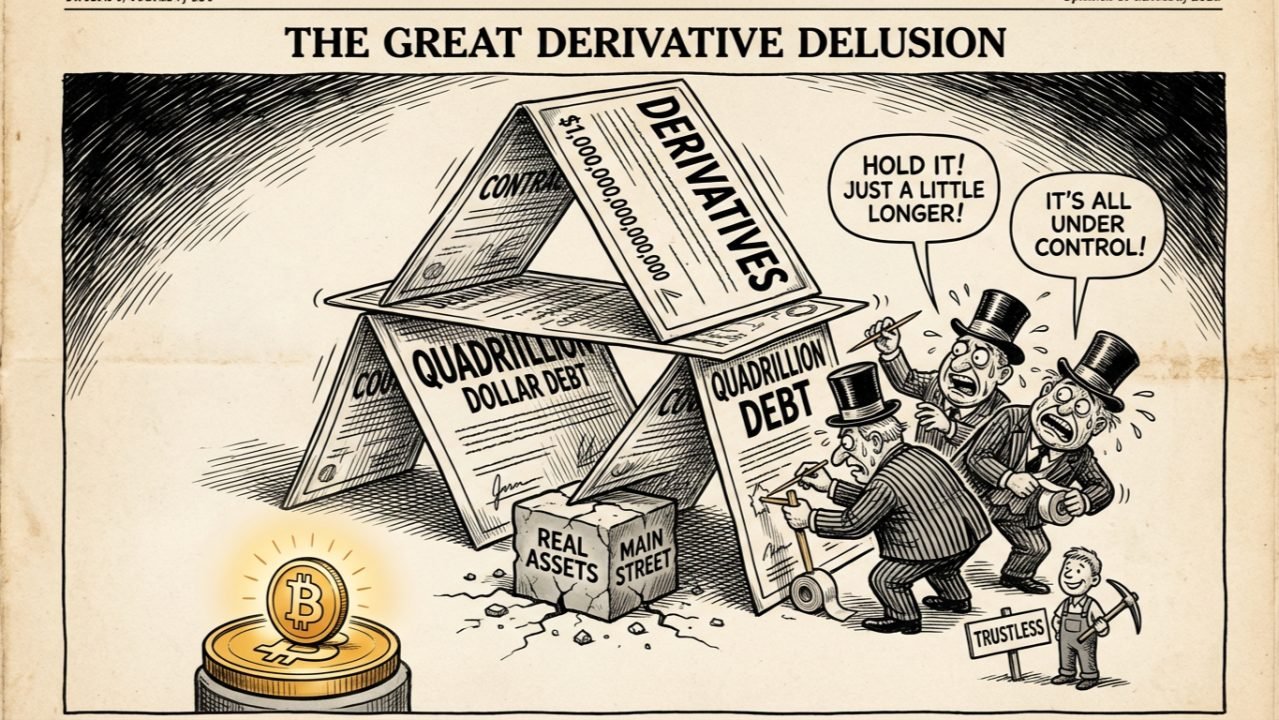
In the world of high finance, there exists a number so vast it borders on insanity. The figure is one quadrillion dollars. The number makes me picture monopoly money or some kind of a figure from a fiction story.
This figure is often cited as the total size of the global derivatives market, a sum more than ten times the world’s total GDP (1). It is a number that evokes a sense of awe and, for those who look closer, a profound sense of unease. This financial superstructure, built on layers of complex contracts, represents the single greatest systemic risk to the global economy. It is a house of cards built on a fault line, and understanding its fragility is key to understanding the absolute necessity of Bitcoin.
Notional vs. Real: The Great Deception
The quadrillion-dollar figure refers to the notional value of outstanding derivatives contracts. This is a critical distinction. Notional value is the theoretical value of the assets a contract controls, not the actual money that has been invested or is at risk (2). For example, a single S&P 500 futures contract might have a market value, or cost to purchase, of a few thousand dollars, but its notional value could be over half a million dollars, representing the value of the stocks it controls (3).
This gap between notional value and real market value is the great deception of the derivatives market. It allows for the creation of immense leverage, where a small amount of capital can control a vast amount of underlying assets. The official notional value of the over-the-counter (OTC) derivatives market is estimated by the Bank for International Settlements to be in the hundreds of trillions (4). Even just using this more conservative figure represents a staggering level of interconnected paper claims on real-world assets. The gross market value, or the actual money at risk, is significantly smaller, but it is the notional value that reveals the true scale of the systemic web.
A History of Collapse: Paper Promises and Real-World Crises
This is not a theoretical risk. The history of modern finance is littered with the wreckage of derivatives-fueled collapses. In 1998, the world had a preview of the danger with the near-failure of Long-Term Capital Management (LTCM). LTCM which was hedge fund, run by a team that included two Nobel laureates, used immense leverage, at one point holding about $30 in debt for every $1 of capital 5. When its bets went wrong following a Russian debt default, the fund lost 44% of its value in a single month, threatening to bring down the entire financial system with it. A bailout, facilitated by the Federal Reserve, was required to prevent a catastrophic fire sale (5).
Just a decade later, the 2008 financial crisis provided an even more devastating lesson. The collapse was triggered by the implosion of the subprime mortgage market, but it was amplified into a global meltdown by derivatives, specifically credit default swaps (CDS). Companies like AIG sold these instruments as “insurance” on mortgage-backed securities. When the underlying mortgages defaulted, AIG faced tens of billions of dollars in losses it could not cover, creating a black hole of counterparty risk that threatened to bankrupt every major bank it had dealt with. The U.S. government was forced to step in with a bailout that ultimately totaled over $180 billion to prevent a complete systemic collapse 6.
In both cases, the core problem was the same: a daisy chain of interconnected obligations where the failure of one counterparty could trigger a cascade of defaults across the entire system. This is the essence of systemic risk, a feature, not a bug, of the modern derivatives market.
Bitcoin: The Exit Door From the Casino
In a system built on layers of promises and IOUs, Bitcoin represents a radical departure. It is a final settlement asset with no counterparty risk. When you hold self-custodied Bitcoin, you do not hold a promise to be paid. You hold the asset itself. There is no issuer, no debtor, and no chain of obligations that can fail.
This is why Warren Buffett famously called derivatives “financial weapons of mass destruction” (7). They are a web of promises, and in a crisis, those promises are only as good as the counterparty that made them. Bitcoin is the antithesis of this structure. Its value is not derived from a claim on another asset or the performance of a third party. Its value comes from its absolute scarcity, its decentralized and censorship-resistant network, and its mathematical certainty.
As the derivatives illusion inevitably unravels, whether through a slow unwinding or a sudden crisis, capital will flee from counterparty risk. It will seek a safe haven, an asset that cannot be printed, devalued, or defaulted on. It will seek an asset that is not someone else’s liability. In that flight to safety, the world will discover what a small but growing number of investors already understand: the only true safe haven is a bearer asset with no counterparty risk. The only true safe haven is Bitcoin.
At Halfacre Research, our entire philosophy is built on this principle. We do not speculate in the paper casino. Our algorithmic systems are designed to accumulate more Bitcoin, the real asset, not the paper claims on it. In a world built on a quadrillion-dollar illusion, we focus on the only thing that’s real.
References
[[1] Investopedia: How Big Is the Derivatives Market?](https://www.linkedin.com/redir/redirect?url=https%3A%2F%2Fwww%2Einvestopedia%2Ecom%2Fask%2Fanswers%2F052715%2Fhow-big-derivatives-market%2Easp&urlhash=c5gi&trk=article-ssr-frontend-pulse_little-text-block)
[[2] Investopedia: Understand Notional Value and Market Value in Contracts](https://www.linkedin.com/redir/redirect?url=https%3A%2F%2Fwww%2Einvestopedia%2Ecom%2Fask%2Fanswers%2F050615%2Fwhat-difference-between-notional-value-and-market-value%2Easp&urlhash=KFfu&trk=article-ssr-frontend-pulse_little-text-block)
[[3] Investopedia: Real-World Examples: Notional vs. Market Value](https://www.linkedin.com/redir/redirect?url=https%3A%2F%2Fwww%2Einvestopedia%2Ecom%2Fask%2Fanswers%2F050615%2Fwhat-difference-between-notional-value-and-market-value%2Easp%23toc-real-world-examples-notional-vs-market-value&urlhash=jkTi&trk=article-ssr-frontend-pulse_little-text-block)
[[4] Bank for International Settlements: OTC derivatives statistics at end-June 2024](https://www.linkedin.com/redir/redirect?url=https%3A%2F%2Fwww%2Ebis%2Eorg%2Fpubl%2Fotc_hy2411%2Ehtm&urlhash=e92J&trk=article-ssr-frontend-pulse_little-text-block)
[[5] Federal Reserve History: Near Failure of Long-Term Capital Management](https://www.linkedin.com/redir/redirect?url=https%3A%2F%2Fwww%2Efederalreservehistory%2Eorg%2Fessays%2Fltcm-near-failure&urlhash=I5fz&trk=article-ssr-frontend-pulse_little-text-block)
[[6] Investopedia: Why the U.S. Government Bailed Out AIG: A Detailed Analysis](https://www.linkedin.com/redir/redirect?url=https%3A%2F%2Fwww%2Einvestopedia%2Ecom%2Farticles%2Feconomics%2F09%2Famerican-investment-group-aig-bailout%2Easp&urlhash=zHKT&trk=article-ssr-frontend-pulse_little-text-block)
[[7] Berkshire Hathaway Inc. 2002 Chairman's Letter](https://www.linkedin.com/redir/redirect?url=https%3A%2F%2Fwww%2Eberkshirehathaway%2Ecom%2Fletters%2F2002pdf%2Epdf&urlhash=YW2a&trk=article-ssr-frontend-pulse_little-text-block)